
Your phone is ringing. And ringing. And ringing.
Someone should probably get that.
The Calls You Never Knew You Lost
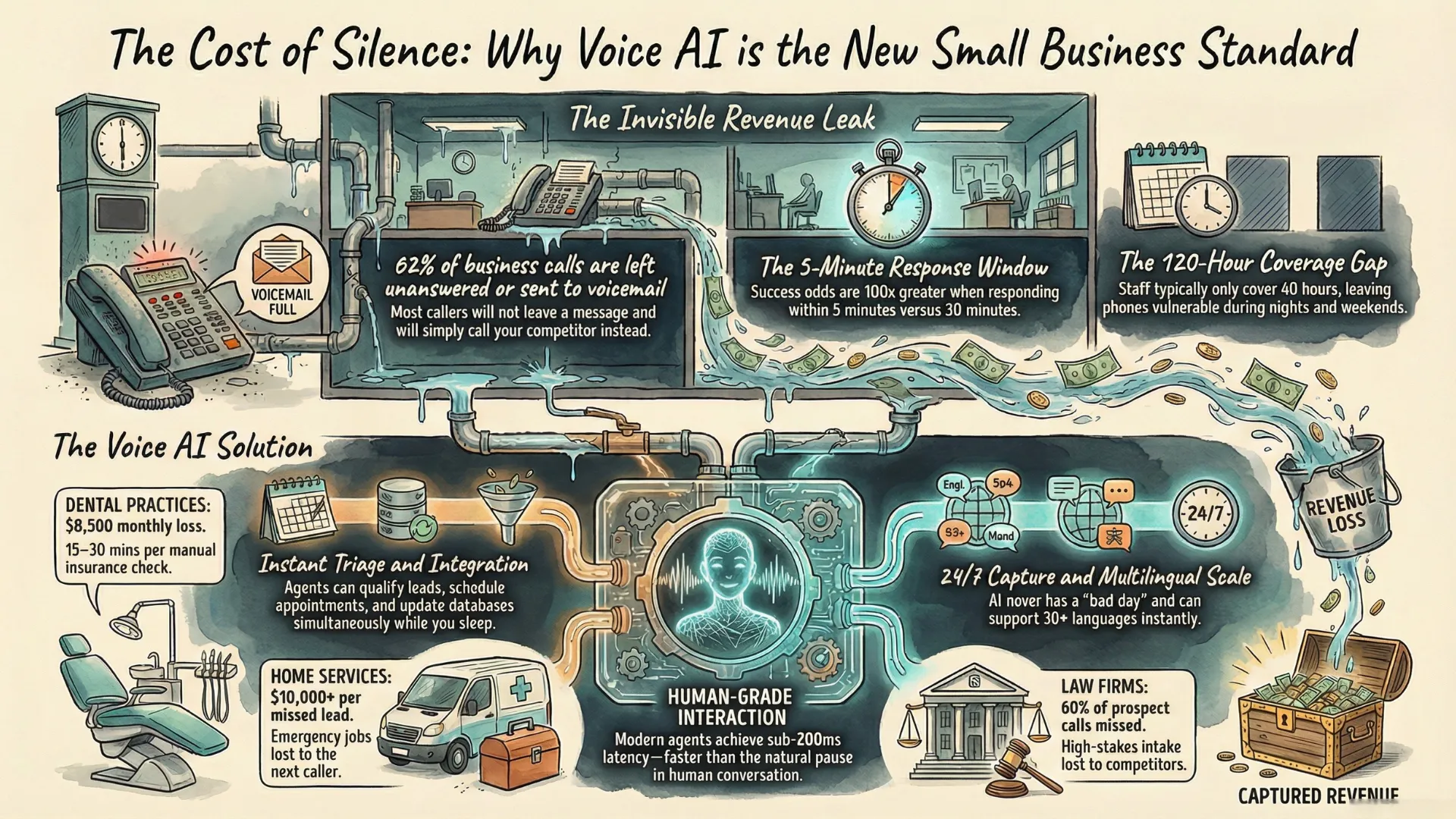
Leads go cold really fast. Study on Lead Response has shown that odds of making successful contact are 100 times greater when you respond within 5 minutes compared to 30 minutes. Even more striking: the odds of that lead entering your sales process—actually becoming qualified—are 21 times greater at the 5-minute mark versus 30 minutes.
Now consider this: a 2016 study by 411 Locals—which monitored 85 businesses across 58 industries for 30 days—found that only 37.8% of calls were actually answered. Another 37.8% went to voicemail. The remaining 24.3% got no response at all. Six out of ten calls, unanswered.
Nearly a decade later, the problem persists. Industry-specific studies consistently find that 25-50% of business calls go unanswered. The specific rates vary by vertical, but the pattern is universal—and we’ll explore what this means for your specific industry below.
If you’re a business owner, you probably think you’re doing better than that. After all, you have staff. Someone answers the phone. But consider when those calls actually come in:
- During the lunch rush when your host is seating guests
- At 7 PM when your receptionist has gone home
- During that staff meeting when everyone’s in the back
- On Saturday morning when your office is closed but a pipe is bursting
Here’s where it gets worse. Industry research consistently shows that the majority of callers—estimates range from 50% to 80% —won’t leave a voicemail. They won’t call back tomorrow. They won’t send an email instead. They’ll call the next business on their list.
The cruelest part? You’ll never see this loss on any report. You can’t track the customers who never became customers. The phone rang, nobody answered, and the opportunity evaporated without a trace.
What does this cost? It depends on your industry—the math involves customer lifetime value, purchase frequency, and referral potential. A single missed call rarely represents a single transaction. We’ll break down the specific economics for several industries in the next section.
Until recently, there wasn’t a cost-effective solution. Hiring additional staff meant salary, benefits, training, and coverage gaps. Answering services meant hold music and awkward transfers. After-hours coverage meant night-shift wages or simply accepting the loss.
Voice AI has changed that equation entirely—and the timing matters more than you might think.
Why Now: The 2026 Adoption Window
If you’ve dismissed voice AI before, you’re not wrong to have been skeptical. A few years ago, the technology wasn’t ready. Today, several forces have converged to create what may be the clearest adoption window in a decade.
I published Voice-First: the Next Paradigm Shift is Coming in 2024. That trajectory is accelerating.
The Technology Works
In May 2024, OpenAI released GPT-4o—the first major AI model with multi-modal capabilities (processing text, audio, and images in one system) that could natively understand and generate speech without relying on separate transcription systems. Response latency dropped to 232 milliseconds. By October 2024, OpenAI’s Realtime API enabled developers to build voice agents with persistent conversations and the ability to check databases or update systems mid-call.
Those releases marked a significant milestone. Since then, the space has moved fast—Google, XAI, ElevenLabs, and dozens of specialized voice AI providers now offer competing solutions, each optimizing for different trade-offs in latency, accuracy, language support, or integration depth.
The result? Voice AI agents that actually feel like talking to a person:
- Latency: Industry leaders now achieve ~200ms response times—on par with natural pause between human conversational turns.
- Accuracy: Speech recognition has reached as low as 3.3% word error rate.
- Natural conversation: Models now support full-duplex speech capabilities (two-way simultaneous communication, like a real phone call)—they can listen while talking, handle interruptions, and maintain context across exchanges
This isn’t theoretical. Speechmatics reported that voice agent usage grew 9x in 2025.
The Economics Have Shifted
The math has fundamentally changed—and not just because of cost. AI solves a problem people alone can’t solve.
Your staff works 40 hours per week. Your phone is open 168 hours per week. That’s a coverage gap of 120+ hours—nights, weekends, holidays, lunch breaks, sick days. Traditionally, filling that gap meant expensive night shifts, impersonal answering services, or simply accepting the loss.
Voice AI agents have made 24/7 coverage accessible to businesses of any size—no night-shift wages, no impersonal answering services. The technology handles the hours your team can’t: the Saturday emergency, the simultaneous callers during rush, the 10 PM inquiry.
The math is straightforward: take your missed calls, multiply by those who won’t leave voicemail (typically half or more), multiply by your conversion rate, multiply by customer lifetime value. That’s your invisible monthly loss—revenue that evaporates without a trace. We’ll show you industry-specific numbers below, and they’re often staggering.
Your Competitors May Already Be Moving
Here’s the uncomfortable reality: while you’re reading this, your competitors may already be deploying.
A May 2025 Thryv survey of 540 small business decision-makers found that 55% of SMBs now use AI in some capacity—up from 39% just one year earlier. Among businesses with 10-100 employees, adoption rose from 47% to 68%.
The pattern extends beyond small business. McKinsey’s 2025 Global Survey found that 88% of organizations now use AI in at least one business function.
But here’s a striking fact: a 2025 Workato study tested 114 B2B companies for lead response time. Not a single one called back within 5 minutes. Only 42% called within an hour. The average phone response time was 14 hours and 29 minutes.
Remember the Lead Response Study: the 5-minute response window matters enormously. The businesses that deploy voice AI agents to answer immediately will capture leads their competitors are still “getting back to” tomorrow.
The competitive gap isn’t theoretical—it’s measurable, and it’s widening.
What This Means for Your Industry
The missed call problem hits different industries in different ways. Here’s what the data shows for businesses like yours.
Dental Practices
The Problem: Front desk staff juggle check-ins, insurance calls, and appointment scheduling simultaneously. The morning rush—when new patients call—is exactly when staff are least available to answer.
The Stakes: A new patient is worth approximately $850 in their first year. Miss 10 new patient calls this month? You’ve just lost $8,500. Multiply by 12 months: $102,000 in annual revenue—gone to dentists who answered the phone. And that’s just year one. Over a patient’s lifetime, those 10 monthly missed calls represent over $700,000 walking out the door.
There’s a compounding cost, too: insurance verification consumes 15-30 minutes per new patient as staff navigate payer portals and hold queues. That’s time they can’t spend answering the next call.
The Opportunity: Voice AI agents don’t just answer—they can collect insurance information during the initial call and integrate with practice management systems. The verification that tied up your front desk becomes automated background work.
Home Services (HVAC, Plumbing, Electrical)
The Problem: Emergencies don’t respect business hours. The “no heat” call comes in the middle of the night. The flooded basement happens on Sunday. Invoca’s research shows 27% of home services calls go unanswered during business hours—and the after-hours rate is significantly higher.
The Stakes: Emergency calls carry the highest revenue potential. A system replacement can exceed $10,000. When a homeowner with a broken furnace in January gets voicemail, they’re not leaving a message—they’re calling the next number on Google.
The Opportunity: Voice AI agents provide true 24/7 coverage with intelligent triage. “Furnace clicking but producing some heat” routes differently than “gas smell in the basement.” The AI dispatches emergencies immediately while scheduling routine calls for the next business day. The math is straightforward: one captured emergency job often exceeds $10,000 in revenue.
Law Firms
The Problem: The legal industry’s phone problem is getting worse. Clio’s 2024 Legal Trends Report found only 40% of law firms answered calls from prospective clients—down from 56% in 2019. Nearly half were essentially unreachable by phone.
The Stakes: Legal intake is high-stakes. A single personal injury case can generate tens of thousands in fees. Unlike a dental appointment that can be rescheduled, a potential client who can’t reach you will sign with someone else within hours.
The Opportunity: After-hours intake is particularly valuable. Accidents don’t happen 9-to-5. A voice AI that collects case details, assesses urgency, and schedules consultations ensures the 11 PM car accident victim becomes tomorrow’s consultation—not a competitor’s client.
Restaurants
The Problem: Peak call times—5-7 PM for reservations, lunch and dinner rushes for takeout—coincide exactly with when staff are busiest serving guests. The host seating a party of eight can’t simultaneously answer the phone.
The Stakes: Each missed reservation is a lost table. Each missed takeout order is immediate revenue gone. While individual transactions are smaller than other industries, volume compounds: a busy restaurant can miss dozens of calls weekly during rushes.
The Opportunity: Voice AI agents handle the predictable interruptions—reservation requests, hours and directions, basic takeout orders—freeing staff to focus on guests physically present. The phone stops degrading in-person service.
Real Estate
The Problem: In real estate, response time is everything. Potential buyers move fast—the first responder wins. Yet most agents are showing properties, in meetings, or simply unavailable when leads come in.
The Stakes: Real estate commissions often exceed $10,000 per transaction, and leads are expensive to generate. When a motivated buyer reaches out and gets voicemail, they don’t wait—they call the next agent on their list.
The Opportunity: Voice AI agents ensure instant response to every inquiry, 24/7. When a potential buyer submits interest at 10 PM, they can receive a call within seconds—qualifying budget, timeline, and preferences while scheduling a showing. The AI handles initial contact and consistent follow-up, then hands off to human agents when the lead is ready for a real conversation.
Property Management
The Problem: Maintenance emergencies don’t respect business hours. A tenant with a burst pipe at midnight needs immediate response. But staffing a 24/7 maintenance line is expensive, and on-call managers burn out fast.
The Stakes: Unaddressed emergencies become disasters. Water damage, security issues, and heating failures escalate from hundreds to thousands of dollars if response is delayed. Tenant satisfaction—critical for renewals—plummets when emergencies go unanswered.
The Opportunity: Voice AI agents triage in real-time: “Is the water shut off? Can you access the main valve?” It troubleshoots remotely, dispatches vendors when genuinely urgent, and schedules routine issues for the next business day. The property manager sleeps while tenants get immediate response.
Automotive Service Departments
The Problem: Service departments are profit centers—contributing up to 49% of a dealership’s total gross profits according to NADA data. Yet service advisors are constantly pulled away from the phone—walking the lot, consulting with technicians, or helping customers at the counter.
The Stakes: The average repair order runs several hundred dollars. Missing even a fraction of inbound service calls creates significant revenue leakage. Independent shops face the same dynamic with smaller margins for error.
The Opportunity: Voice AI handles appointment scheduling, service status inquiries, and recall notifications—the routine calls that interrupt constantly. The result: better customer experience on the phone and in person simultaneously.
Does Your Phone Ring?
The industries above are just examples. The question isn’t whether your specific vertical is on this list—it’s whether your business has phones that ring.
Veterinary clinics face dynamics similar to dental. Insurance agencies depend on persistent follow-up. Fitness centers battle member churn. Salons and spas lose revenue to no-shows. Staffing agencies drown in candidate outreach. The list goes on: accounting firms, medical specialists, auto body shops, tutoring centers, event planners, cleaning services—anywhere customers call and sometimes don’t get through.
If your phone rings, and you sometimes miss it, the economics apply to you.
And it’s not just about answering. Voice AI agents also handle outbound—appointment reminders that reduce no-shows, follow-up calls that nurture leads, re-engagement campaigns for lapsed customers. The same technology that answers your phone can proactively reach out on your behalf.
Beyond the Phone: What Voice AI Unlocks
Voice AI isn’t just about answering calls you’d otherwise miss. It enables capabilities that weren’t previously economical:
True 24/7 operations — Not “leave a message after hours,” but actual service. The midnight emergency becomes tomorrow’s job, not a competitor’s. For some businesses, this transforms the value proposition entirely—you become the provider who’s always there.
Instant response at scale — Five callers during the lunch rush don’t hear hold music. They all get immediate attention simultaneously. This isn’t about saving labor costs; it’s about serving customers who would have hung up.
Market expansion — 30+ languages without multilingual staff. Your serviceable market just grew. The caller who previously couldn’t communicate now becomes a customer.
Consistency — The AI doesn’t have bad days, doesn’t rush when stressed.
Data you’ve never had — Every call becomes searchable, analyzable. Which questions do customers ask most? What times are busiest? Which responses convert? Six months in, you’ll understand your phone traffic in ways that were never possible before.
Your team handles what humans do best: judgment calls, relationship-building, complex problem-solving. The AI handles what would otherwise go unanswered—the after-hours emergency, the simultaneous callers during rush, the caller who prefers another language.
This isn’t about replacing a receptionist. It’s about capturing revenue that currently evaporates—and unlocking capabilities that weren’t possible before.
The Reality Check: Execution Matters
While the economics are compelling, a word of caution is necessary regarding how you implement. You may have seen the headlines: the share of businesses scrapping their AI initiatives jumped to 42% in 2025. Some estimates place the failure rate for general AI projects as high as 80%—twice the rate of failure for standard IT projects.
However, it is critical to distinguish between “moonshot” AI experiments and proven Voice AI solutions. General AI projects often fail because businesses misunderstand the problem they are trying to solve, focusing on “shiny” technology rather than specific outcomes. Voice AI is different. The core technology is no longer experimental; it has clearly crossed the reliability threshold and is ready for business.
So, if the technology is ready, why do businesses still struggle? The most important failure mode for Voice AI isn’t necessarily capability; it could be data readiness, continuous oversight, and system integration.
According to researchers from RAND, Stanford, and Gartner, successful implementation requires a rigorous infrastructure that most small businesses cannot build alone.
- The Myth of “Plug and Play” Data: A voice agent is only as smart as the information it accesses. Informatica reports that while businesses have plenty of data, they lack “AI-ready data”—information that is dynamic, contextual, and standardized. If your agent cannot distinguish between a “consultation” and a “check-up” because your booking system is messy, it creates frustration rather than efficiency.
- The “Drift” Danger: AI models are not “set it and forget it” tools. Without “AI observability”—the ability to monitor performance and accuracy—models suffer from “drift,” where their behavior degrades over time.
- The Infrastructure Mandate: Stanford researchers identify “Infrastructure Strategy” as a non-negotiable pillar of success, requiring significant computational power and scalability. Similarly, Gartner identifies seven distinct workstreams—from AI engineering to governance—required to keep a project viable. Attempting to manage this internal complexity often leads to the “pilot trap,” where projects never scale beyond a simple test.
This is why the “who” matters as much as the “what.” The difference between a stalled experiment and a revenue-generating asset is usually the partner managing it. RAND suggests that to avoid failure, leaders must invest in specialized infrastructure and technical expertise upfront.
What If You Wait?
You might be thinking: I’ll get to it eventually. It’s not urgent.
Here’s the problem with that logic: the advantages compound over time, and waiting has costs you won’t see on any report.
Every call your AI handles generates data. Which questions do callers ask most? What times are busiest? Which responses lead to bookings versus hang-ups? Six months in, early adopters have thousands of interactions teaching their systems exactly how their customers communicate. You’ll be starting from zero.
Meanwhile, the competitive dynamic shifts beneath you. Remember: not a single company in the Workato study responded to leads within 5 minutes. The business that does—consistently, around the clock, including holidays—doesn’t just win that lead. They build a reputation for responsiveness that becomes its own marketing.
Deepgram’s 2025 State of Voice AI report put it plainly: “Organizations that fail to implement will risk falling behind as human-like AI becomes the expected standard.”
The question isn’t whether voice AI will become standard. It’s whether you’ll be ahead of that curve or scrambling to catch up.
Assess Your Opportunity
Before you decide, answer two questions:
- How many calls go unanswered? Count the missed calls, the after-hours voicemails, the callers who hung up during the lunch rush. If you don’t know, that’s the first problem—consider tracking for a month. The number will likely surprise you.
- What’s a customer worth to you? For a dentist, a single patient is worth thousands of dollars over their lifetime. For a law firm, potentially tens of thousands per case. For a restaurant, it’s every visit they’ll ever make plus everyone they recommend.
Now multiply. That’s what’s at stake—and what your competitors capture when they answer and you don’t.
The technology works. The economics make sense. For most businesses, this is no longer optional—it’s the new baseline for customer responsiveness.
Talk to us about your business. We’ll show you what’s possible.